Une approche d'apprentissage par transfert pour la classification de l'état des disques lombaires
2022-01-08
Ali Al-kubaisi 1 and Nasser N. Khamiss 2
1 Computer Center, University of Anbar, Ramadi, Iraq; alijamal530@uoanbar.edu.iq
2 Department of Networks Engineering, Information Engineering Collage Nahrain University, Baghdad, Iraq; nassrnafea@gmail.com
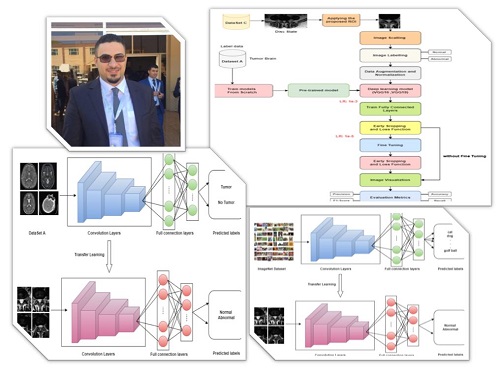
Recently, deep learning algorithms have become one of the most popular methods and forms of algorithms used in the medical imaging analysis process. Deep learning tools provide accuracy and speed in the process of diagnosing and classifying lumbar spine problems. Disk herniation and spinal stenosis are two of the most common lower back diseases. The process of diagnosing pain in the lower back can be considered costly in terms of time and available expertise. In this paper, we used multiple approaches to overcome the problem of lack of training data in disc state classification and to enhance the performance of disc state classification tasks. To achieve this goal, transfer learning from different datasets and a proposed region of interest (ROI) technique were implemented. It has been demonstrated that using transfer learning from the same domain as the target dataset may increase performance dramatically. Applying the ROI method improved the disc state classification results in VGG19 2%, ResNet50 16%, MobileNetV2 5%, and VGG16 2%. The results improved VGG16 4% and in VGG19 6%, compared with the transfer from ImageNet. Moreover, it has been stated that the closer the data to be classified is to the data that the system trained on, the better the achieved results will be.
Keywords: transfer learning; deep learning; lumbar spine disc classification; lumbar spine; medical image analysis; artificial intelligence; machine learning; convolution neural network
Site of Journal : https://www.mdpi.com/journal/electronics